Friday, September 2, 2011

Writing The Season – What It Means


My guest is author Kenneth Weene. He shares a bit about the importance of writers setting a mood for the reader to visualize and store a sense of season. With the right choice of words we can create a happy setting or an ominous tone in our work.


It isn’t just the weather, not even the color; it’s the whole mood. That’s what changes from season to season.

It isn’t enough to say that the colors of autumn fill the little town in which your story is set. It isn’t even sufficient to mention the cold rain carrying that first hint of the fluffy snow yet to come. Sure there’s football in the yard and the crunch of dead leaves underfoot. Then the inviting smell of burning wood carried by thin wisps of chimney smoke in the ever-crisper nights. If you are into astronomy, you can change the constellations. If you are into gastronomy, what local foods now grace the table? Having grown up in New England, for example, I would be remiss if I didn’t mention a pumpkin pie or suggest that apple cider, perhaps redolent of cinnamon, is being drunk. Ah, those pesky kids have loaded the cider with raisins and sugar in the hopes of a more potent brew. The sense of autumn is everywhere.

Have you, however, noticed something else? I have slowly portended something joyous, as pleasant as a game of tag football in the yard or rolling together in the just-piled leaves. I have set the mood for something to happen, something perhaps a bit delightful. We anticipate winter and Christmas, playfulness, and kids having good-natured if naughty fun. (And yes, in case you were wondering, the mention of constellations is intended to help generate an awareness of forecasting the future.)

Consider the above paragraph if I were to change it just a bit. Here are the changes (replacing the italicized sections above).

It isn’t even sufficient to mention the cold rain carrying that first hint of the wet-footed misery yet to come.

Then the acrid smell of burning wood

in the slightly darker evenings.

Ah, those damn kids have loaded the cider with raisins in the hope of a foul-smelling but potent brew.

The new description offers a less happy fall. I have now set the mood for something perhaps a bit off, certainly unpleasant, to happen.

Setting the sense of the season to the mood of our narrative is one way we can subtly bring our readers into the story. Staying with autumn as the example, suppose the writer wants to do something sexual with the story. Then perhaps we can have deer rutting or possibly go back to the pleasure of that leaf pile but instead of crunching the leaves can tickle or comfort. On the other hand, if the story is about loneliness, do not the yearlings go off to find their own lives? Do not the birds migrate leaving behind their empty nests?

Writing the seasons into you story adds a dimension that few readers will recognize but to which almost all readers will respond.

One last piece of advice: Like all writing tricks, this is one that can easily be overdone. Set the stage, but never overdress it. If a writer constantly describes the weather, the reader will stop reading those passages. Unlike the filmmaker, who can provide a constant sense of ambiance, the writer has to content himself with setting the stage infrequently and must therefore do so in a way that will motivate the reader to visualize and to store a sense of the stage in her (his) own mind. 


  • How do you show the season in your story?


Memoirs From The Asylum


What is it like to work inside a state hospital or to be a patient in such a hospital? What is it like to live inside the mind of such a patient? This tragi-comedic novel takes the reader inside the asylum, inside the worlds of three central characters: a narrator who has taken refuge from his fears of the world, a psychiatrist whose own life has been damaged by his father's depression, and a catatonic schizophrenic whose world is trapped inside a crack in the wall opposite her bed. This is the interwoven story of their lives, a story that includes love, sexuality, violence, deaths, celebrations, circuses, and surprising twists. As the plot unwinds, the reader learns a great deal about the nature of futility, frustration, and freedom. Excerpt (click on excerpt tab on the right)

Buy: Amazon


A New Englander by upbringing and inclination, Kenneth Weene is a teacher, psychologist, and pastoral counselor by education.

Ken’s short stories and poetry have appeared in numerous publications including Sol Spirits, Palo Verde Pages, Vox Poetica Clutching at Straws, The Word Place, Legendary, Sex and Murder Magazine, The New Flesh Magazine, The Santa Fe Literary Review, Daily Flashes of Erotica Quarterly, Bewildering Stories and A Word With You Press.

Ken’s novels, Widow’s Walk and Memoirs From the Asylum are published by All Things That Matter Press.
To learn more about Ken’s writing visit: http://www.authorkenweene.com 


.     

Wednesday, August 31, 2011

CAN TWO AUTHORS SHARE ONE OFFICE AND ONE COMPUTER?

My guest is historical romance author, Mary Ellen Dennis. Mary Ellen has two books out this month. The featured book, The Greatest Love on Earth and a reissue by Sourcebooks, The Landlord's Black-Eyed Daughter. You can read a bit about that one at the end of the article. 

Mary Ellen seems a bit conflicted, even a dual personality--no worries, she's perfectly safe--but I'll let her explain that to you...


Can two authors share one office and computer?


Sure they can, if they are the same person :-)

Denise [Deni] Dietz and Mary Ellen Dennis share one room, one desk, one computer, and one keyboard. Deni writes mysteries that have no socially redeeming values whatsoever. They are meant only to entertain. Mary Ellen writes historical fiction that is ageless. The romance in both genres is supplied…or maybe a better word would be inspired…by their mutual best friend, lover and husband, novelist Gordon Aalborg. Gordon's office is upstairs, in the loft, and he sends Deni emails suggesting they meet for coffee. Meanwhile, his photo graces the desk she shares with her alter-ego.

Deni met Gordon, aka Harlequin romance author Victoria Gordon, on-line through an authors’ loop. Gordon was living in Australia, Deni lived in Colorado. They decided to collaborate on a romantic suspense and fell in love, sight unseen. Gordon asked Deni to marry him. She replied, “I think I should meet you face-to-face, first.” He described his house, which included a guest bedroom, and invited her to visit him in Tasmania. She said she had a strict book deadline. He said, “Silly wench, I have a computer.” So Deni hopped a plane to the land of Kangaroos, Koalas, and Hugh Jackman. She knew that she and Gordon were soul mates. She hoped there’d be “chemistry,” and there was. Sparks flew. Almost immediately, Deni and Gordon sold up, packed up, and bought a cottage on Vancouver Island. They were married at a writers conference and will celebrate their 11th anniversary this October. Deni says, “You’ve never been romanced until you’ve been romanced by a romance author.”

Deni and Mary Ellen both think writing should be fun as well as creative, so the items on their computer desk tend to make them smile. First and foremost, one's gaze is drawn to a Gumby-like statue of Edgar Allen Poe, looming over a red Staples "That was easy" button.

Deni has a wonderful photo of her actress sister, Eileen Dietz ( www.eileendietz.com ), who played the possession scenes—and The Demon—in The Exorcist. Eileen inspired Deni to write FIFTY CENTS FOR YOUR SOUL, a somewhat supernatural novel that revolves around events that occurred during the filming of The Exorcist—a novel that Publishers Weekly called "Hollywood noir."

Deni likes to listen to show music. On her side of the computer desk she has a stack of CDs that include Les Mis, Once Upon a Mattress, Candide, Phantom of the Opera, and a dozen other Broadway shows (she hopes someday to appear on Jeopardy and hit the Broadway Musicals category). She also has the Dixie Chicks, Harry Chapin and Barbra Streisand. Mary Ellen prefers Celtic music and drove Deni daft by listening non-stop to Loreena McKenna's "The Highwayman" while writing THE LANDLORD’S BLACK-EYED DAUGHTER.

Above the computer desk there’s a framed poster of Daniel Day Lewis in The Last of the Mohicans, looking just like Rand, Mary Ellen’s hero in “Landlord.” There is also a circus poster of a bareback rider on a white horse, inspiration for Mary Ellen’s THE GREATEST LOVE ON EARTH.

Deni’s stuffed "deadline vulture" perches on top of the modem. She named it Michael Seidman after her first editor. Deni and Mary Ellen share a heavy rock, ostensibly a paperweight, that has CREATE chiseled on its surface. They also share a small ceramic tortoise. It reminds them that if you only write one page a day, by the end of the year you'll have written a book. Both write more than one page a day. Deni owns a small ceramic frog in a witch’s hat, seated behind a crystal ball. The frog inspires her to write TOE OF FROG (aka "The DaVinci Toad"), her sequel to her romantic mystery, EYE OF NEWT, starring reluctant witch Sydney St. Charles. In “Frog” readers will meet a “reincarnated Rottweiler” who is afraid of doorbells and songs from the 1970s.

Excerpt
One wall of the office is devoted to Deni and Mary Ellen’s book covers. In the place of honor are the covers for THE LANDLORD’S BLACK-EYED DAUGHTER and THE GREATEST LOVE ON EARTH. Don’t you agree that they are both beautiful covers? In fact, the drop-dead gorgeous highwayman depicted on “Landlord” won a Romantic Times KISS (Knight in Shining Silver) contest.

Finally, Mary Ellen collects angels. Her favorite angel holds a piece of paper with a Luciano de Crescenzo quote: "We are each of us angels with only one wing and we can only fly by embracing each other."


  • What is your favorite piece of furniture, or picture, or keepsake—something that sets off a fun memory or begins a new memory?
~*~*~*~


The Greatest Love On Earth—Mary Ellen Dennis. Available now

He's fearless, except when it comes to Calliope Kelley...

Nothing could shake the courage of lion tamer Brian O'Connor, until the circus is threatened and the love of his life deserts him...

Danger, drama, dazzling excitement are her world...

Bold, beautiful Calliope Kelley would jump through flaming hoops to protect her father's circus. But when disaster strikes and Calliope loses everything, she knows she must build brand new dreams... 
Torn apart and betrothed to others, a twist of fate brings Brian and Calliope back under the bigtop, where together they'll walk the high-wire to see if great loves turn to ashes or rekindle to burn brightly forever...Excerpt

BUY: Amazon, Amazon.ca, Barnes and Noble, Books-A-Million  Available in ebook and print


Former singer/actress and perennial rule-breaker Mary Ellen Dennis is the author of several award-winning historical romance novels and culinary mysteries and is growing her audience for both. She is married to novelist Gordon Aalborg (aka Victoria Gordon), whom she met online through a writer's group; they live on Vancouver Island. She has two books in stores this month, released by Sourcebooks Casablanca: The Greatest Love on Earth—set in the exotic world of a 19th century circus and sweeps readers into death-defying feats, dangerous rivalries, and a love that has all the thrills and romance of the greatest show on earth., and a reissue of The Landlord’s Black-Eyed Daughter: A fast-paced and passionate retelling of the story of two timeless lovers who would die for each other. If only they didn’t have to. This gorgeous romance gives the poem a whole new depth and a happy ending. 

For more information, please visit www.maryellendennis.com.

.

Friday, August 26, 2011

When Lightning Strikes


My guest today is author, Smoky Zeidel. She's a free-spirited writer she hails from the San Gabriel Mountain area in California. She's worn many hats in her life, wife, mother, teacher, book reviewer for several newspapers and magazines, author, and survivor. 


Smoky shares a bit with us about her writing journey and how an intriguing box of letters dating from the 1920's inspired her book, On the Choptank Shores.


I've wanted to be a writer ever since the fourth grade, when I first picked up the book, Harriet the Spy. I adored Harriet. I emulated her, carrying around a notebook and making notes on everything I saw going on around me. I think—no, I know—I annoyed my friends terribly doing this, so after a few weeks, I quit doing this.

But I didn’t quit writing. I acquired my first diary Christmas of that same year, and have kept diaries and journals ever since. That’s now almost forty-five years of writing something almost every day!

Life got in the way of my trying to write professionally until the day my life changed dramatically: July 11, 1989. At 10:17 that morning, I took a direct hit from a bolt of lightning. I nearly died. I guess technically I did die; I had no heartbeat when the paramedics arrived on the scene.

But, I lived, albeit with a rather broken body. I had heart damage, nerve damage, damage to the cartilage in my knees. My right ear drum vaporized. My jaw was smashed. Flash burns covered my body. Not a pretty picture.

My body was broken, yes. But my mind was as healthy and curious as ever! A few years after the lightning, I was at home, recovering from one of my now more than a dozen surgeries (I’ve lost count). I saw an ad in my local hometown newspaper advertising for freelance feature writers. I wrote the editor a letter, arguing that while my degree was in psychology, not journalism, anyone who took seventeen years to complete their BA degree because they tried to major in everything except physics obviously could write a good paper, and therefore would make a good feature writer. I got hired immediately.

My feature writing career flourished, because I could work when I felt well and turn down assignments when one of my health issues flared up. But deep inside, I wasn’t content. I wanted to write fiction, to follow the dream I’d had since childhood.

Then one day my parents came to visit. My mother brought me a box of love letters written between my favorite aunt and uncle during their courting days, back in the 1920s. They told a fabulous story of love, of struggling through hard times, of separation, of reunion. I somehow knew these letters were meant to be a book.

My first novel was borne of those letters, albeit not in the way I intended. They inspired me to sit at my word processor (this was long before I had a PC!) and imagine what life would be like, struggling to farm land with poor soil, to work with your hands, not machines, to truly survive, not simply exist. My first novel, Redeeming Grace, was borne of that imagining.

Unfortunately, my first publisher went under several months after my book was published. But that really didn’t matter. I quickly found a new publisher, and I’ve been writing books for them ever since.

I still have health issues, twenty-two years after the lightning. I had my third knee replacement only eight months ago (and yes, I have only two knees!); just last week I keeled over in a dead faint at my desk and was hospitalized because of some neurological glitch in my brain. I have chronic pain issues that make it impossible for me to write on some days; impossible for me to even get off the couch.

Yet, I persevere. I have a wonderfully supportive husband, Scott, who himself is an artist, a classical guitarist. He nurtures me when I’m sick and down, but as I heal, he has just the right way of nudging me back into my office to write. And my publisher, Kimberlee Williams of Vanilla Heart Publishing, has been more than fabulous. In fact, she just gave that first book of mine new life—it has just been re-released with a more appropriate title and a beautiful new cover, as On the Choptank Shores: A Love Story. And, to my delight, it is finally reaching readers, who have raved about it, I am happy to say.

I don’t recommend you stand out in a storm and get struck by lightning in order to get motivated to write! But sometimes life hands you a raw deal. You’re going to live through it whether you lie on the couch and moan and grown, and you’re going to live through it if you get up, greet each day with a smile, write your books, and live your life. 


Which life would you choose? I, for one, choose the latter!


ON CHOPTANK SHORES: A Love Story. Available now.

On the Choptank Shores is set on Maryland's eastern shore in the late 1920's. Happy endings, in novels as in life, sometimes come at a heavy price.
The tragic deaths of her mother and two younger siblings have left Grace Harmon responsible for raising her sister Miriam and protecting her from their abusive father, Luther, a zealot preacher with a penchant for speaking in Biblical verse who is on a downward spiral toward insanity. 

Otto Singer charms Grace with his gentle courtship and devotion to his brother, Henry, but is unable to share with Grace the terrible secret he has kept more than twenty years. 
 
Luther's insane ravings and increasingly violent behavior force Grace to question everything she ever knew. Then, tragedy strikes just when Otto's secret is uncovered, unleashing demons that threaten to destroy the entire family. Can Grace find the strength to save them all? Excerpt
Buy:  Amazon, Smashwords 


Smoky Trudeau Zeidel is the author of two novels, On the Choptank Shores (formerly titled Redeeming Grace) and The Cabin, and two nonfiction books on writing. She is also the author of Observations of an Earth Mage, an enchanting collection of prose, poetry, and photographs celebrating the beauty and splendor of the natural world. All her books are published by Vanilla Heart Publishing.


 In a Flash, where she recounts the story of how she was struck by lightning and how the experience has affected her life in the more than two decades following the event.
A popular book reviewer, Smoky wrote reviews for several newspapers and magazines before starting her blog, Smoky Talks Books. She specializes in reviewing books published by small and independent presses and by emerging writers.
Known to her fans as The Earth Mage, Smoky lives her life honoring Mother Earth through her writing, visual art, and spiritual practice. She lives in California with her husband Scott (a college music professor and classical guitarist), her daughter (a college student and actress), and a menagerie of animals, both domestic and wild, in a ramshackle cottage in the woods overlooking the San Gabriel Valley and Mountains beyond. When she isn’t writing, she spends her time hiking in the mountains and deserts, splashing in tidepools, and resisting the urge to speak in haiku.


Wednesday, August 24, 2011

MY BIGGEST WRITING CHALLENGE


It's my pleasure to have author, Kathryne Kennedy, visiting Over Coffee again. I truly enjoy having authors visit, of course, but one the added benefit of this blog is being able to have those authors whose books I love to read. I love vivid worlds peopled by unforgettable characters and settings. Kathryne's books always provide me with an escape into a new place. Her stories are better than Calgon at taking away, lol!

I have to admit, I wondered about her writing process. She graciously shares with us her greatest challenge in telling her stories. 


Thank you so much, Sia, for having me here today. It’s such a pleasure to talk with you and your readers once again! I’m looking forward to responding to the comments.

Today I thought I’d share one of my biggest challenges in telling a story, and I hope both readers and writers find it helpful.

I often find that the biggest challenge I face in telling a story is in how I write. I admire writers who can write anywhere, under any circumstances. But for me, I have to have total focus on my story and characters, and distractions can make that difficult.

A reader once told me “You paint pictures with words.” It made me really look at how I sit down and write a story. I always have a general idea of the plot—where the story will take me—and I have a general idea of my character’s strengths and weaknesses. But the story itself unfolds as I write, and I have to see each scene in my head—I have to be in that scene—before I can get it down in words. If I can’t visualize it, I can’t write about it. I can’t pass along that vision to my reader.

It kinda works the same way with my characters. I have to get back into their heads before they can move forward in a scene. Their personalities grow with each page and any decision or action they take is based on their choices, not mine. So even something as minor as walking across a room, or as major as making love, has to be in their character, with their motivation and purpose.

So what happens when I can’t find my focus? When other issues (like life) cloud my thinking? I’ve found several things that help:


  • I read my last few pages, allowing me to immerse myself back into the scene or characters. And if that doesn’t work, I’ll go back even farther, until I truly empathize with my characters again, and am living back in their world.

  • I make a list of all the things that are demanding my time or mental energy, put it aside with the promise that I will get to each issue after I write my goal for the day. This helps focus my full attention back on my writing.

  • If I’m facing the end of a scene and am not sure where to go next, I go back to my original outline for the general plot, and that gives me back my direction.

  • I help myself the day before. When I’m immersed, the ideas start flowing. So before I stop writing for the day, I’ll put short notes right where I've left off, telling what will happen next in the scene.

  • If I’m having a truly difficult time facing the keyboard, I give myself permission to stare at a blank screen. I do not have to write anything. I will just sit down and stare at the screen. This relieves the pressure, and my mind and fingers have yet to fail to get something written for that day…even though I don’t ‘have’ to.

  • If you’re a writer and share my challenges, I hope you’ve found some of my solutions helpful, and I sure would like to hear any you might like to add.
  • If you’re a reader, I hope this post helps you to understand what my writing process is like, and I’d love to hear what you think.


THE LADY OF THE STORM BY KATHRYNE KENNEDY—IN STORES AUGUST 2011
Giles is bound to protect her...
In a kingdom viciously ruled by warlike elven lords, village blacksmith Giles Beaumont reluctantly swears to protect the half-elf, half-human Cecily Sutton, never dreaming that he will fall under her enchanting spell.
But duty soon turns to desire...
When Cecily's father disappears, Cecily and Giles set out to find him. But, as their journey unfolds, duty is quickly replaced by desire—and the search for Cecily's father leads to a magical destiny that could end the rule of the elven lords forever...Excerpt.  BOOK TRAILER


THE LADY OF THE STORM is a great read for those who love epic fantasy romance... love story between two strong-minded people set against the backdrop of intrigue, magic, 
and incredible danger.

“Fantastical creatures, magical spells, lengthy quests, angst, and passion will satisfy readers looking for a romance plot in a well-developed fantasy setting.”
Publishers Weekly

“Kennedy’s exquisite world building and terrific plotting make this a must-read.”
Booklist Starred Review

Buy: AmazonBarnes and NobleBordersBooksAMillion,
Chapters/IndigoKathryne’s Bookseller Directory

The publisher is giving away two copies of The Lady Of The Storm, to two commenters on today's blog. Limited to the US and Canada. IF you want to be entered into the drawing for her book, please contact me at siamckye@gmail.com with your contact info. Thank you!


Kathryne Kennedy is an acclaimed, best-selling, award-winning author of magical romances. She welcomes readers to visit her website where she has ongoing contests at http://www.kathrynekennedy.com/. She’s lived in Guam, Okinawa, and several states in the U.S., and currently lives with her wonderful family in Arizona, where she is working on the next book in The Elven Lords series, The Lord of Illusion (February 2012).

Monday, August 22, 2011

MONDAY MUSINGS: Endings The Good And Ugly


Ever read a good book or see a good movie with good characters and the ending sucks?

My husband and I watched Country Strong. Good actors, conflict, music and then splat. I thought, oh, come on. You can’t be serious—after all that, someone is going to walk away from a contract like this? Right. Wait a minute, a comeback like this and she goes into her dressing room and does what? Please.  I don’t care how good the rest of the movie was the ending ruined it all for me. It made me mad because it could have been excellent. I couldn’t figure out why it bombed at the box office—until the ending and then I understood.

My husband and I had quite a discussion regarding endings.

There are some movies I watch because I like the actor/actresses and usually they don’t act in crappy movies. Until recently any Nicolas Gage movie was one I watched. Now, I’m a bit more careful to look at the storyline first because of the next two movies.

City of Angels. Great cast, love Meg Ryan and Nicolas Gage, which is why I decided to watch it to begin with. Good premise. After all the two of them went through, she dies? Really? Major suckage. Had it been a book I would have thrown it across the room in disgust.

Then there was Knowing. Trailers looked good, actors were good, and lots of action (my kinda movie) and then the movie went to hell the last ten minutes. I felt robbed.

There are certain books that do the same. Nicolas Spark’s books. The Notebook was reasonable given the history and time frame. I’m not saying he’s a bad writer but I don’t like his style of telling a story. I really tried to read his others but ugh—ditto with the movies, excellent though the cast was. His books are not only no, but hell no. (Yes, I’m sure there are those who just love stories like his.)

The way I see it, and this is my opinion and my preferences only, when I see a movie or read a book, I want the bad guys get their asses kicked and the good guys win the day. If one of the main cast of characters has to die, make it count. Give me a reason. Even ordinary people facing extraordinary circumstances can be heroic though they die. A good example of that, in my opinion, was the movie Independence Day. The Randy Quaid character died. Another one was Armageddon, Bruce Willis is a main character and he sacrifices himself for his daughter’s sweetheart. Okay, I would have preferred them to remain alive but their deaths were logical and in line with the sort of characters they were. Their deaths counted. The good guys still won.


Evil loses, good wins. Yes, I know it’s not always the reality in life, but if I want a heavy dose of reality, I’ll turn on the news or read a newspaper. And please, don’t give me an ambiguous ending—which happens in some movies and literary pieces I’ve read. I don’t mind drawing my conclusions but at least make the ending positive enough so I can at see the hero or heroine is on a better path after all they’ve gone through

For me, no matter how good the book or the movie if the ending doesn’t deliver and isn’t satisfying, why bother? No, it doesn't have to be all sunshine and butterflies, but I like a good finale. I don’t want it rushed and slapdash and I want it to fit the strengths of the characters the author/writer has created.


  • What about you?  What are your thoughts on endings? What makes an ending good in your opinion?

Friday, August 19, 2011

WHAT CAME FIRST… the Author or the Egg?


It's my pleasure to welcome author, Jerri Corgiat, to OVER COFFEE. Jerri is the author of Love Finds A Home series which she originally wrote and published through Penguin Signet and is now available in ebook format from Istoria Books.

As readers we fall in love with authors and the worlds they create. Some of these authors influence what we write. Jerri shares some who have influenced her and why.


So the other day, my epublisher, Istoria Books, asked me if there were any books in the public domain by authors who had influenced my writing. I took a gander at Project Gutenberg (link at end) and turns out there is. Louisa May Alcott.

This got me thinking about books I’ve read, public domain or not, that have influenced what I write. Louisa May Alcott’s Little Women and Little Men and Jo’s Boys. All the books by Janet Lambert. And Georgette Heyer.

Louise May Alcott needs no introduction. Who doesn’t know Little Women, right? To my mind, the much less famous Janet Lambert, a prolific young adult writer from 1941 to 1969, should need none, either.
What they have in common is they wrote—and wrote well—about families. Big families. They also wrote series. Little Women was the most famous of a trilogy.

And Janet Lambert… fifty-four books, most interrelated.  In 1941, in Star-Spangled Summer, she gave readers Penny Parrish, daughter of an Army officer… and for the next twenty-eight years, she doled out books about Penny’s siblings and Penny’s children and Penny’s friends and people who spun off from those books and by the time she was done, Penny was a forty-something actress… what a body of work.

Whether it was Orchard House or an army post in Fort Riley, Kansas, these authors created a world.

As an adolescent in the late 1960s, I stumbled into these worlds. I visited them time and time again. And, in an example of imitation as the best form of flattery, I wrote the Love Finds a Home series, creating, I hoped, a contemporary world where the characters grow and change, move, age, and recover from or celebrate major life events. Even the town doesn’t stand still. To date, there’s a book for each of the three sisters, one for the sister-in-law, and then the fifth, which features the mistress so scorned in the second. And now a sixth is in the writing, starring one of the nieces—only nine when the series started and now twenty-eight. They all have a romance at their center, but family dynamics and topical issues all play a part in shaping the stories.

I’d loved what I’d read in my childhood, so I consciously set out to do something similar. In short, the authors I’ve loved dictate what I write. Or do they?

Although I acquired a stepsister when I was seventeen, I grew up an only child in a big city, a state or five away from extended family. I was introverted and shy, timid in new situations (all very hard to believe now!), and I idealized big families. I idealized small towns. I wanted to be a courageous heroine. I especially wanted to be a gutsy heroine who had the undying love of a valiant man.

So then, nature must have had the edge in determining what I write… or at least that’s what I concluded until I considered the third author I endlessly read as a young woman.
Georgette Heyer.

Readers of romance know her as the Mother of All Regency Romance Authors. She published near-fifty books, beginning in the early 1920s. The last was in 1972. She is a huge favorite of mine; I still have all of her books, dog-eared from the numerous times I’ve read them, which is saying a lot as I’ve shed hundreds of others over the years. I have rarely met an author who could draw a character better than, or even as well as, Georgette Heyer. She illustrated not by telling, but by gesture and action and speech and with such a delightful and subtle, sly wit, I periodically pause in reading her work and want to applaud.

But unlike my aspirations to be the Janet Lambert of contemporary family-saga romance (Louisa May Alcott? I don’t even go there), I don’t want to write Regency Romance. I don’t want to live in that age, or to be bound by convention as her characters are. But I’d be thrilled if I could create one who lives and breathes the way hers do.

Personal predilection likely drew me to reading and writing about big families in little worlds and the intrepid heroine at the center.

And Louisa May Alcott, Janet Lambert…and Georgette Heyer…showed me the best way to do it.


  • I’d love to hear who your favorite authors were when you were young. And, if you’re also a writer, which were the most influential on your work?


Sing Me Home, book one-Love Finds a Home series Jerri Corgiat

Lilac O'Malley Ryan doesn't even recognize country music star Jonathan Van Castle when he bursts into her store. And she's bewildered by what seem like tongue-tied attempts at charm. She just wants to make a sale-and get him out the door. But it turns out to be a lot harder getting that to-die-for smile out of her mind...

 
And once they put their rocky start behind them, Jon and Lil will discover what happens when two unlikely lovers hit the perfect note... Excerpt (you will find the excerpts to all her series in her website sidebar)


When you’re ready to leave here (but not before!), here are some fun sites to visit:

http://www.imagecascade.com/ So much fun to browse among favorite stories for girls published from the 1930s through the 1960s. Gave me warm fuzzies!
http://www.georgette-heyer.com/index.html Lots of enjoyment for Heyer fans or simply if you’re interested in the Regency era. Original book covers, quizzes, bio, tone of information on the era, a fan listserv, suggested books.
http://www.louisamayalcott.org/alcottorchard.html Tour the rooms of Orchard House where Louisa May Alcott lived, wrote, and set her stories.
http://www.gutenberg.org/wiki/Main_PagFree books (in the public domain) for download.

~*~*~


Jerri Corgiat’s five romances in the Love Finds a Home series (Sing Me Home, Follow Me Home, Home at Last, Home by Starlight, and Take Me Home) were originally published by Penguin are now available as ebooks through Istoria Books  Visit Jerri website  or on Facebook 


.

Wednesday, August 17, 2011

OUT OF THE FIRES OF ADVERSITY COMES...LAUGHTER?


Please welcome romance author, Tawna Fenske, to OVER COFFEE. 

We all face adversities and in our lives which can truly impact on not only our life but our writing careers. I’ve always maintained that attitude is half the battle in solving the problems life throws at you, another quarter of it is a heavy-duty catchers mitt and a strong arm to either wrestle it into submission or throw it back. Tawna has perfected the cliché, when life hands you lemons, make lemonade. I’m thinking she might want to follow the advice from gutsy Maxine, and add a bit of salt and tequila gold, too. 

Tawna shares how a comedy romance writer faces trouble. 


My thirty-second birthday left something to be desired. My cat died, my former publisher canceled the line scheduled to release my debut action/adventure novel, and my employer threatened to fire me for disobeying the company’s hosiery policy.

It’s OK if you laughed just now. I laughed, too, even while facing potential unemployment, a derailed writing career, and the challenge of burying a cat whose pronounced rigor mortis required me to dig a grave large enough for an NFL linebacker.

The fact that I could see the humor in what was arguably one of the lousiest days in my life is what nudged me toward writing romantic comedy. Well, that and a lot of wine.

What I didn’t realize at the time was that my ability to keep laughing was going to be tested again. And again. And again.

It took nearly three-and-a-half years after that point before my amazing agent landed me my current three-book deal with Sourcebooks for my romantic comedies. During that long and bumpy period before the deal happened, there were a lot of moments when my laughter was prompted mostly by the thrill of poking push-pins into the groin of my editor voodoo doll.

But after the book deal came through with Sourcebooks, my life was sure to be an endless stream of carefree laughter and cupcakes and puppies that never piddle on your flip-flops, right?

Right.

Over the course of the next twelve months, my marriage of thirteen years began a long, slow, painful swirl around the drain before finally being sucked into the crapper.

Ironic, really, to think I was finally making a name for myself as an up-and-coming romantic comedy author while enduring the least funny, least romantic year of my life.

But I couldn’t spend much time mulling that irony or stopping to wallow in my misery. I had a blog that sometimes saw 1,000 unique visitors a day, most of whom were expecting me to be hilarious and entertaining. I suspected daily recaps of my marriage counseling sessions might miss the mark in both categories.

I also had a new novel to write – the third in my three-book contract. I cringe now to recall how terribly melancholy the early drafts must have been. If you write morose literary fiction, it’s high praise when a critique partner says a scene moved her to tears.

If you write romantic comedy, it’s a sign you need to print out your manuscript, douse it with lighter fluid, and set fire to it in the front yard.

But I persevered, and I learned a helluva lot about my own capacity to take whatever life throws and me and keep going. Those blog readers showing up to see me crack jokes every day turned out to love me just as much when I finally shared news of the divorce.

Their support – along with support from close friends, family, critique partners, beta readers, my agent, editor, and random strangers who offered tissues and penis jokes – helped keep me laughing and plowing forward even on days when I thought I might win an award for being the least funny romantic comedy author on the planet.

I’d like to tell you I’m through the worst of it, but I’m pretty sure that would result in a piano falling on my head or a pack of rabid wolverines tearing through my bedroom door and chewing off my eyelids while I sleep.

But the one thing I know for sure is that I can take it – whatever the hell life throws at me, I’m ready.

And you can be damn sure I’ll dance on the carcass of whatever bad luck has befallen me and I will laugh my fool head off.

That’s a promise.


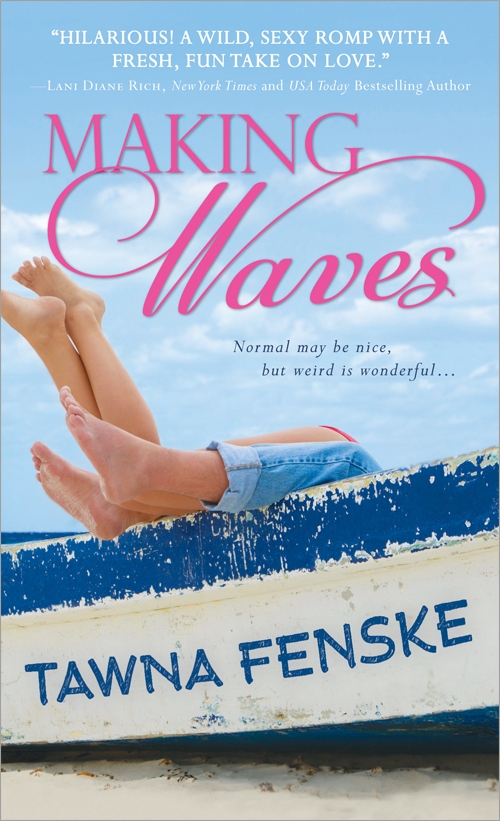
MAKING WAVES BY TAWNA FENSKE – IN STORES AUGUST 2011

She always wanted to belong… Just not to a dysfunctional pirate crew… 

Juli has trouble fitting in, though she’d prefer to keep the reasons to herself. But when she mistakenly stows away on a ship of misfit corporate castoffs, her own secrets become the least of her concerns…

He knows plotting a diamond heist may be considered unusual behavior… 

But Alex isn’t feeling very normal when his unscrupulous boss kicks him to the curb. Meeting Juli doesn’t do much to restore normalcy to Alex’s life either, but it sure is exhilarating!As Alex and Juli bare their secrets—and a whole lot more—they find that while normal is nice, weird can be wonderful…Excerpt

BUY: Amazon, Barnes and Noble, Powells Books 
Available in print or eBook


Tawna Fenske traveled a career path that took her from newspaper reporter to English teacher in Venezuela to marketing geek. An avid globetrotter with a fondness for the sea, she shares her heroine’s violent allergy to seasickness medication (though, sadly, has never stowed away on a pirate ship).Tawna is the author of the popular daily blog “Don’t Pet Me, I’m Writing” and lives in Central Oregon, where she is working on her next novel, Believe It or Not, in stores March 2012. For more information, please visit http://www.tawnafenske.com/ or follower her on Twitter @tawnafenske.